Project Overview
In this project, I analyzed order and item data to understand what drives most warehouse activity and how a warehouse can design storage and picking areas to be faster and more efficient. I created several profiles (item activity, demand, lines per order, order quantity, item family, and units of handling) to identify patterns and support better warehouse decisions.
The main idea is simple: a small portion of SKUs and order types create most of the workload, so the warehouse layout and picking process should be designed around them.
Item Activity Profile (How often items are picked)
This profile shows which SKUs create most of the *picking activity*. A key result was that:
- 1,750 SKUs represent 80% of all activity
- That is about 32.5% of all SKUs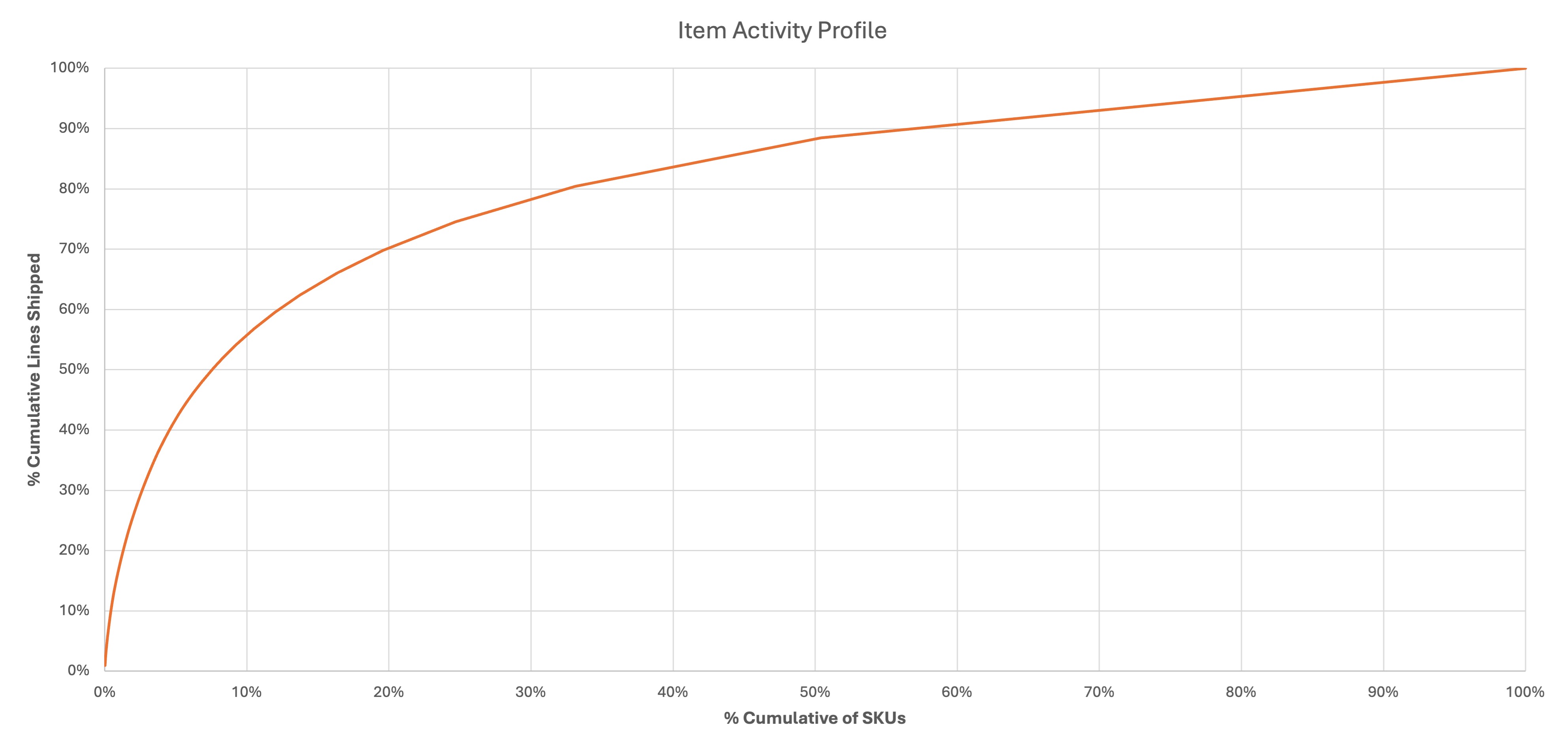
How this helps the warehouse
Since these SKUs are picked the most, they should be placed in the most convenient and accessible storage locations to reduce walking/travel distance. If the warehouse groups items by families (for example, shirts), the same idea can be applied inside each family: place the most active SKUs in the best locations first.
Demand Profile (How much quantity is ordered)
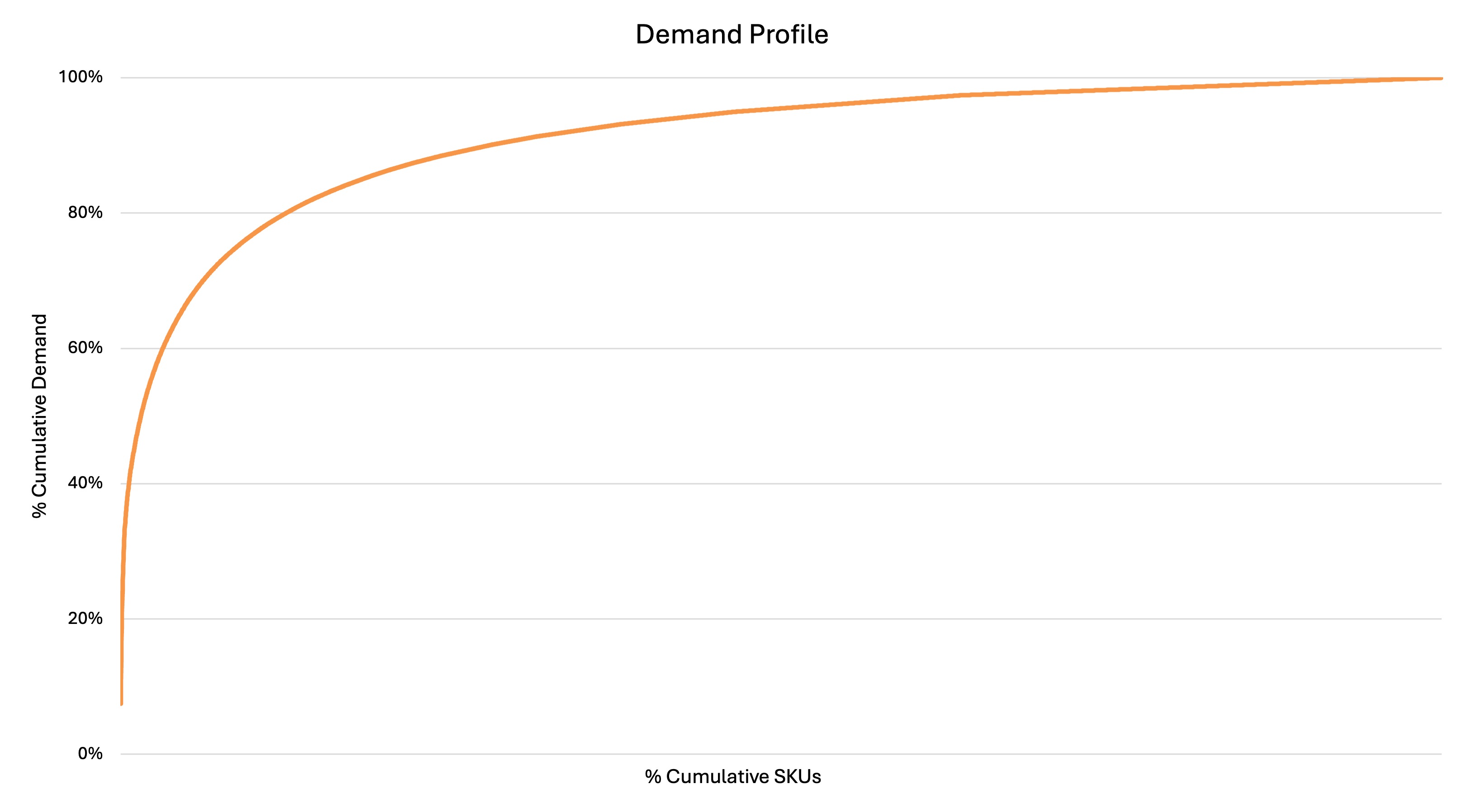
This profile focuses on total quantity demanded, not just how often an item appears.
A key result was that:
- 675 SKUs account for 80% of total demand
- That is about 12.54% of all SKUs
How this helps the warehouse
These high-demand SKUs should be stored where it is easy to replenish and pick frequently. A practical approach is to place fast-moving SKUs in high-access zones and allocate more locations to them to reduce stockouts and reduce replenishment stress.
Lines per Order Profile (How many different items per order)
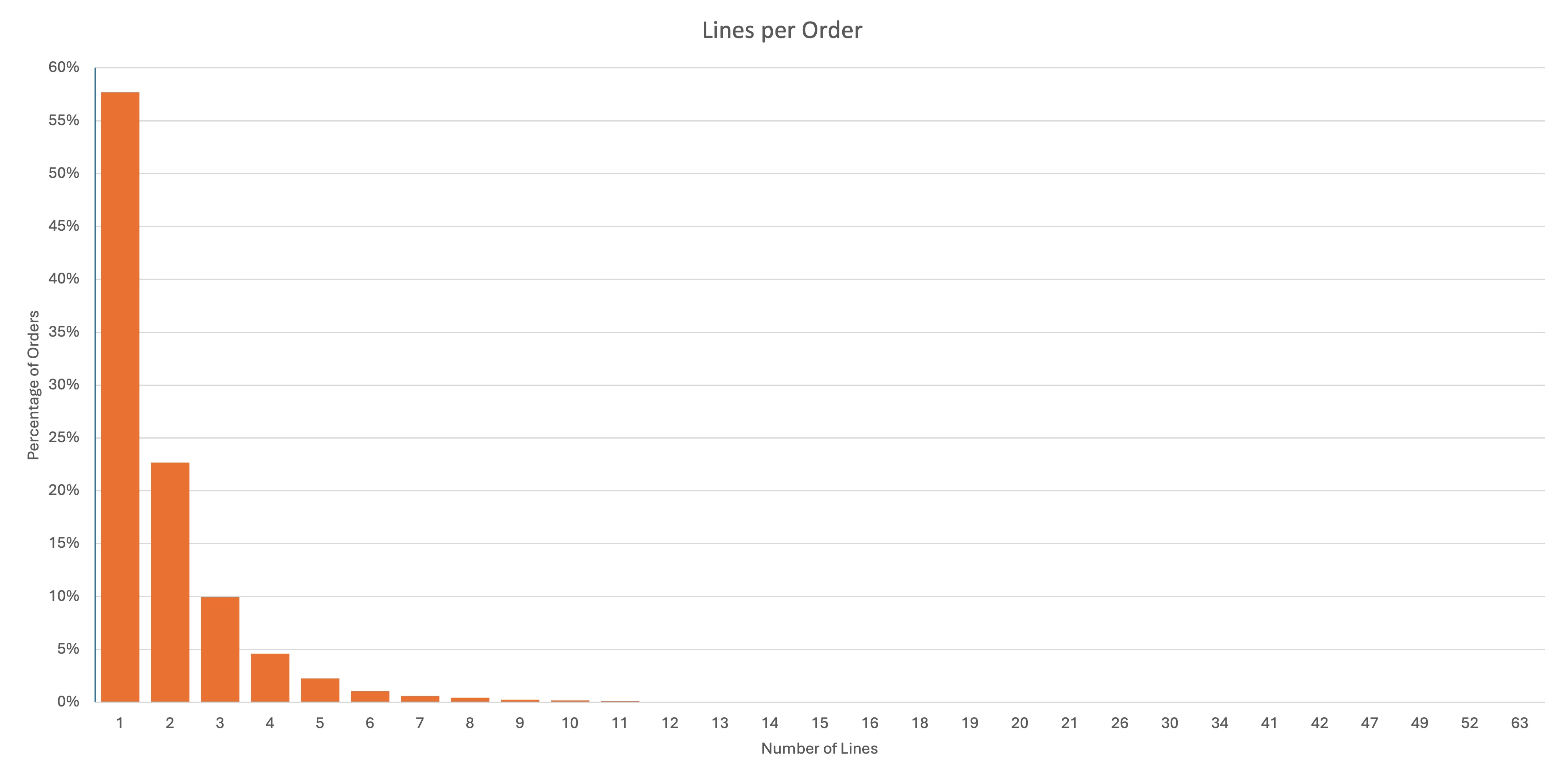
This profile shows how “simple” or “complex” orders are based on how many lines they contain.
A key result was that:
- 57.682% of orders contain only one line**
How to handle these differently
Single-line orders are easier because they require only one stop and do not need sorting between multiple items. These can be processed faster with a dedicated flow (pick → pack → ship). Multi-line orders need multiple stops and usually require sorting, so it makes sense to separate them operationally when possible.
Another useful result was:
- 39.067% of orders contain only one item total (one line and quantity = 1)
For these orders, the warehouse can eliminate extra steps like sorting and reduce packing complexity.
Order Quantity Profile (Full cartons vs broken cartons)
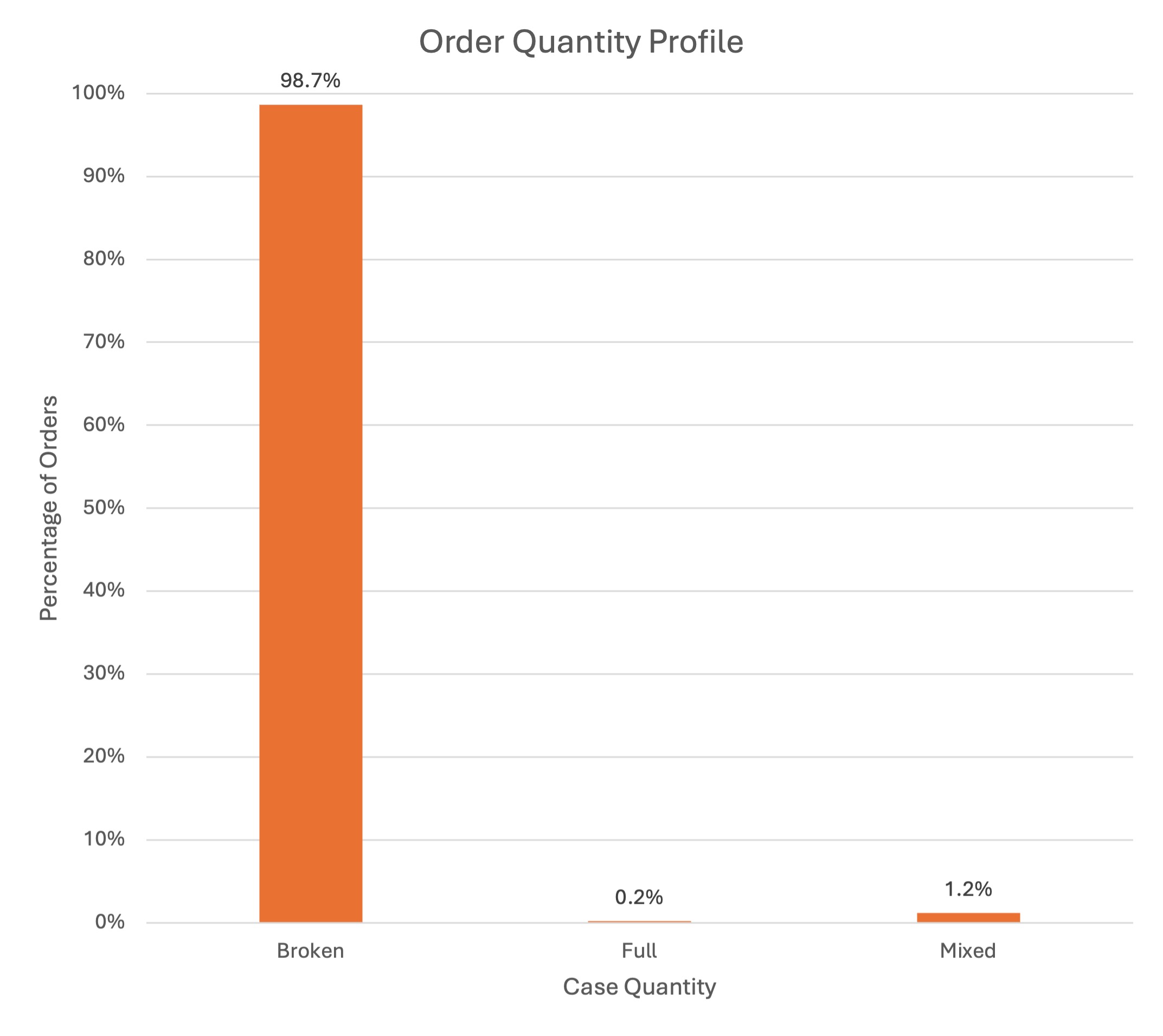
This profile checks whether orders are mostly full-carton picks or broken-carton picks.
Key results:
- 99.16% of orders are broken cartons
- 0.31% are full cartons
- 0.54% are mixed
Warehouse design decision
Because almost all orders are broken-carton picks, the picking area should be designed mainly for broken-case picking. Full-carton orders are very rare, so it would not be efficient to build a large separate full-carton operation. A better idea is:
- One main broken-case picking zone
- A small space for the occasional full-carton or mixed order
Item Family Profile (What families are ordered together)
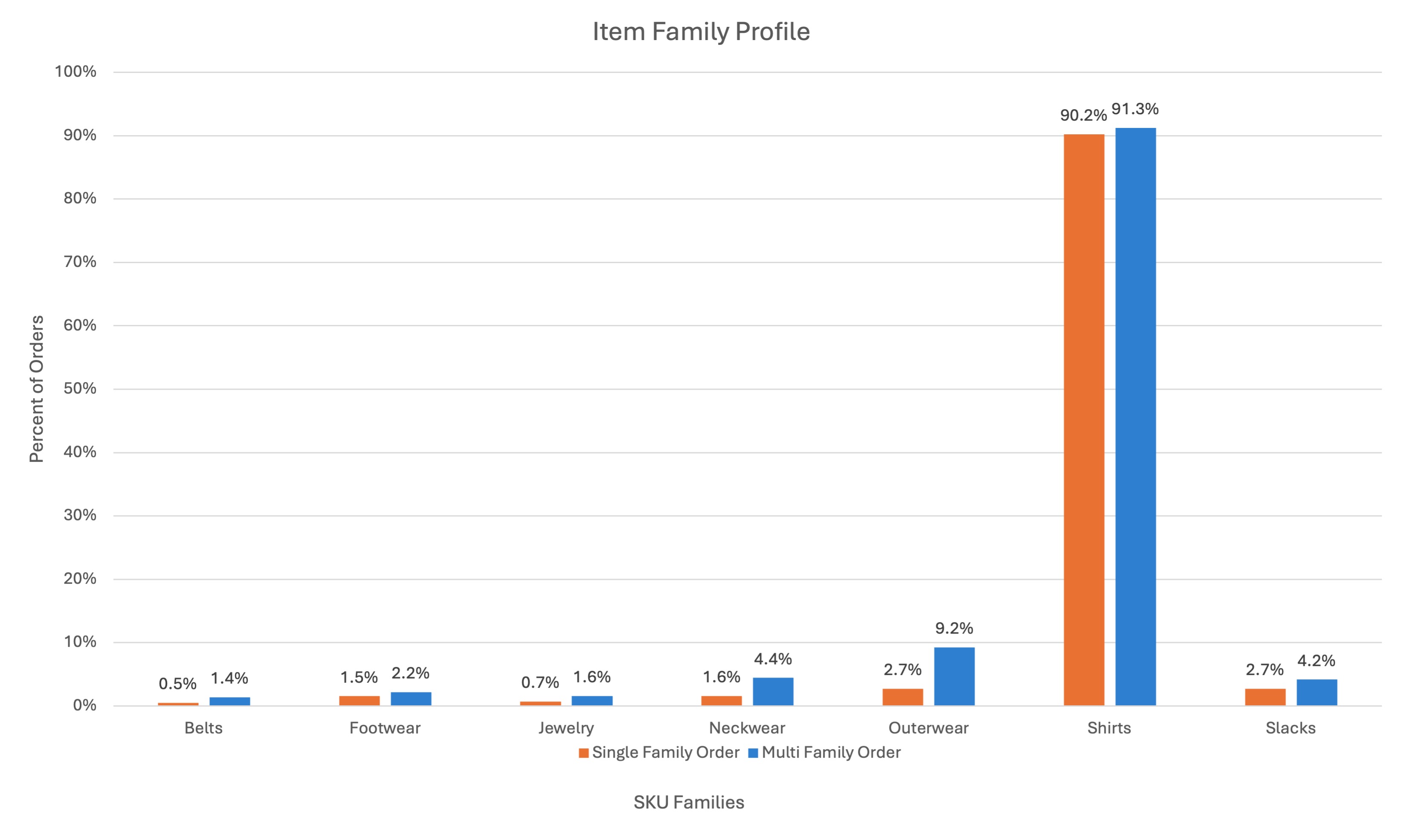
This profile shows which product families dominate orders and whether orders tend to be single-family or mixed-family.
Key result:
- Shirts represent 90.2471% of single-family order
What this means for layout
Since shirts dominate single-family orders, shirt SKUs should be placed close together in convenient locations. Other families can be stored near shirts (but slightly less convenient) if customers often buy shirts and then add another item family. This can reduce travel time for common combinations.
Units of Handling Profile (Common order sizes)
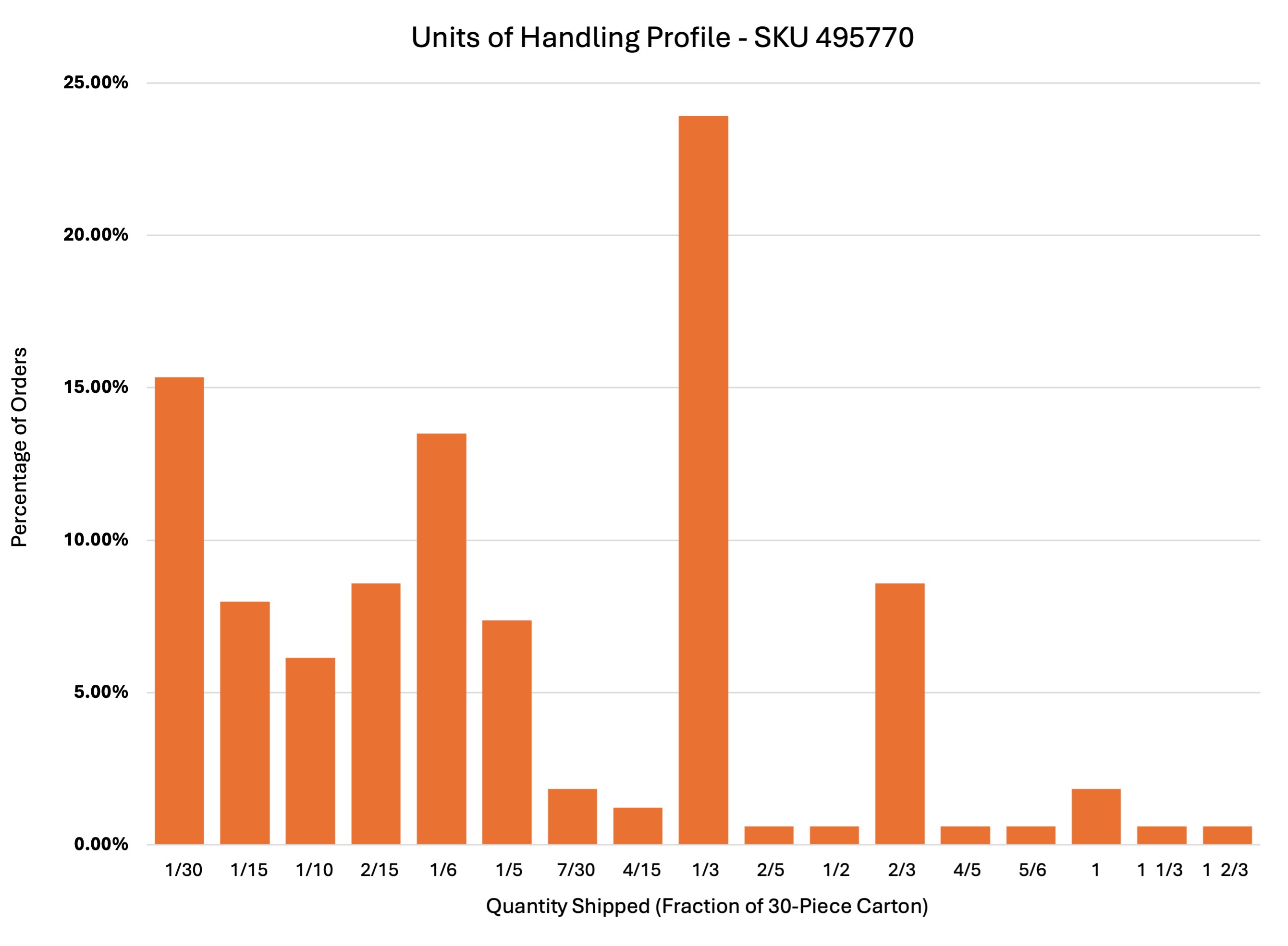
This profile looks at typical quantities ordered relative to the carton size.
Significant peaks in the distribution:
- 10 units (1/3 carton) was the largest peak (~24%)
- Other common peaks: 1 unit (1/30 carton), 5 units (1/6 carton), and 15 units (1/2 carton)
Operational improvement idea: inner packs
If cartons hold 30 units, adding inner packs (like bags) of 5 units or 10 units can help a lot:
- Faster picking (less counting)
- Fewer counting mistakes
- Easier batching for common order sizes
Final Recommendations
Based on all profiles, the main improvements are:
1. Put the highest-activity and highest-demand SKUs in the most convenient locations
2. Design the picking operation mainly for broken-case picking (because that’s almost all orders)
3. Create a fast lane for single-line / single-item orders to speed up flow
4. Group shirt SKUs strategically, since shirts dominate single-family orders
5. Use inner packs (5 or 10 units) to match common order quantities and reduce handling time
Conclusion
This order profiling project shows that warehouse efficiency improves when the operation is designed around real demand patterns. By focusing storage and picking strategies on the SKUs and order types that drive most activity, a warehouse can reduce travel time, improve accuracy, and speed up fulfillment.