Project Overview
In this project, we analyzed the baseline warehouse operations for the ACME case study to understand how products move through the facility and how labor and storage space are currently being used. The purpose of this analysis was to build a clear picture of the existing system before suggesting any improvements.
Overall, the warehouse is heavily focused on eaches picking, which has a major impact on labor requirements and space usage. Understanding this baseline is important because it helps explain where most of the effort and cost in the warehouse comes from.
SKU Characteristics
We started by looking at what the warehouse actually stores.
The facility handles 3,183 SKUs, and the average SKU is relatively small, with a volume of 0.279 cubic feet. Each carton contains 12 units, and pallets hold 16 cartons, or 192 units per pallet.
These details matter because they define how products are stored and handled. Since items are small and cartons are limited in size, the warehouse naturally relies more on carton and eaches handling rather than full-pallet movement.
Order and Unit Quantities
Next, we examined how much product leaves the warehouse on a typical workday.
On average: - About 58,695 units per day are shipped as individual eaches
- Around 3,354 units per day are shipped in cartons
- Only 49 pallets per day are shipped as full pallets
This adds up to roughly 62,098 units per day.
This clearly shows that most outbound volume comes from individual unit picking. Because of this, the forward picking area and order fulfillment processes carry most of the workload in the warehouse.
Flow and Labor Analysis
After understanding the flow, we analyzed how much labor is required to support these operations.
In total, the baseline system requires about 298 full-time equivalents (FTEs). Most of this labor is concentrated in order fulfillment:
- Receiving: 17.8 FTEs
- Put-away: 17.0 FTEs
- Order fulfillment: 207.3 FTEs
- Staging: 29.1 FTEs
- Shipping: 27.2 FTEs
Order fulfillment alone accounts for nearly 70% of the total labor. This is mainly due to the high volume of eaches picking, cartonizing, and sorting required to process customer orders.
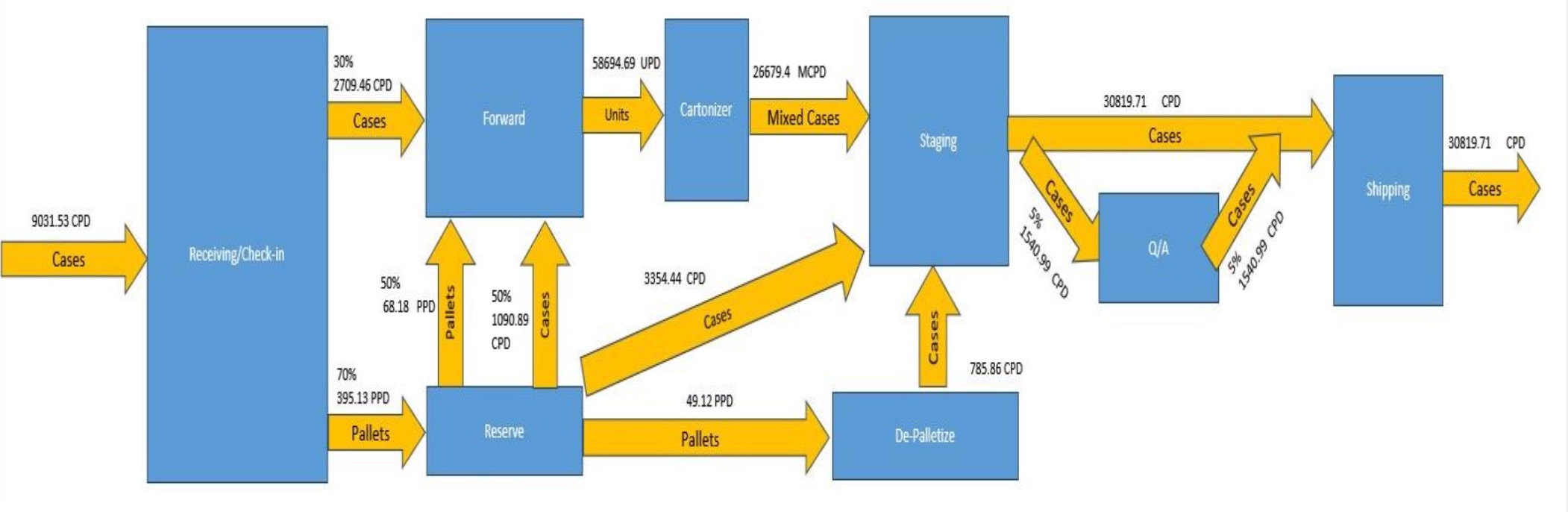
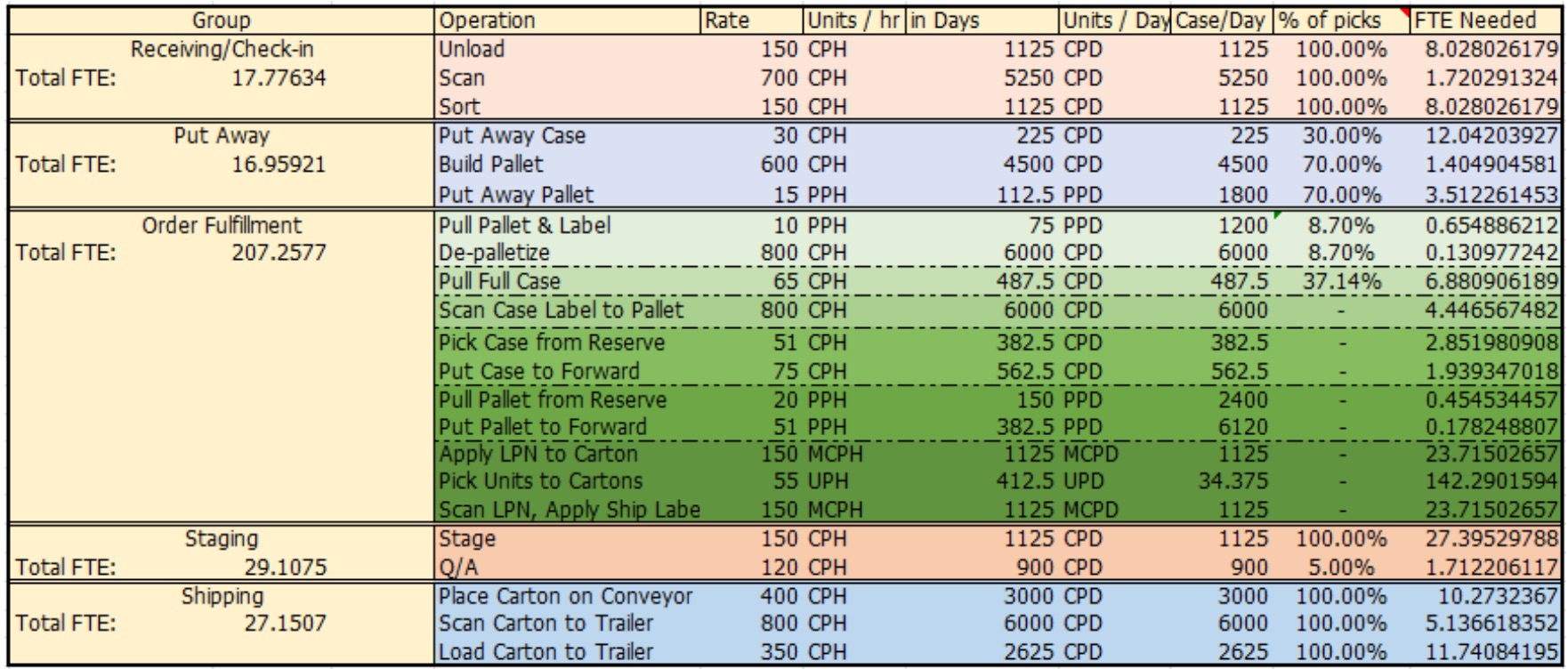
The table shows how much labor each operation needs, while the flow diagram shows why that labor is needed. Together, they explain that the warehouse workload is concentrated in areas that handle small quantities, frequent picks, and multiple handling steps.
Inventory Space Utilization
We also evaluated how efficiently storage space is being used.
When different SKUs are stored in separate pallet locations, the warehouse uses about 79.9% of its available pallet space. However, when quarter, half, and full pallets of the same SKU are allowed to share locations, utilization increases to 85.4%.
This shows that simply consolidating partial pallets can significantly improve space usage without expanding the warehouse or adding more racking.
Storage Layout
The baseline layout consists of 50 aisles with 4 rack levels, providing a total of 47,200 pallet positions.
The forward picking area includes 11,800 bottom-level pallet positions located close to shipping. These locations are assigned based on SKU activity:
- SKU A: 40%
- SKU B: 35%
- SKU C: 20%
- SKU D/E: 5% (stored only in reserve)
This setup prioritizes fast-moving SKUs in the most accessible locations, which helps reduce travel time and supports faster picking.
Key Takeaways
- The warehouse is dominated by eaches picking
- Order fulfillment is the most labor-intensive operation
- Consolidating partial pallets improves space utilization
- Forward picking locations should focus on high-velocity SKUs
- The baseline system works, but there are clear opportunities to improve efficiency
Conclusion
This baseline analysis provides a solid understanding of how the ACME warehouse currently operates. By examining SKU characteristics, order flow, labor requirements, space utilization, and layout design, we highlight where most of the effort is spent and where improvements could have the biggest impact. This analysis sets the foundation for evaluating and designing more efficient warehouse systems.